Saving face
Avoid public embarrassment, loud arguments, or forcing a clear “no.” Calm negotiation and gentle phrasing work better.

Respect local values and integrate smoothly as a Pattaya resident.
Pattaya welcomes millions of visitors, but daily harmony still runs on Thai values — respect, patience, and saving face. Start with the illustrated do's and don'ts (same as the Thai culture page), then use the extended lists for temples, monarchy, and local life.
Avoid public embarrassment, loud arguments, or forcing a clear “no.” Calm negotiation and gentle phrasing work better.
Age, profession, and social status matter. Use polite particles (khrap/kha), wai to elders, and patient tones with officials.
Thais value calm under pressure. Smile, pause, and avoid aggressive body language — especially in traffic or disputes.
Three everyday topics with matching visuals — the same layout as the Thai culture page.
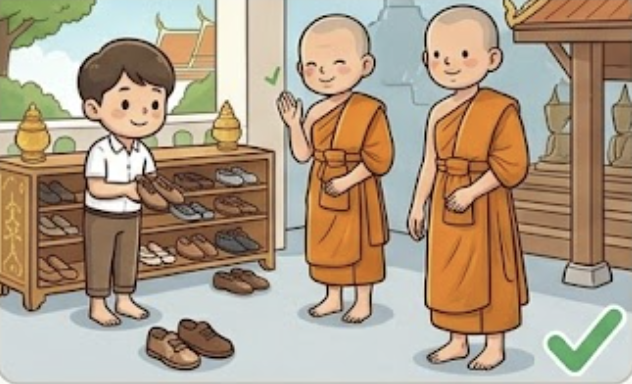
Take off shoes before entering Thai homes and temple buildings. Place them neatly outside — socks are usually fine.
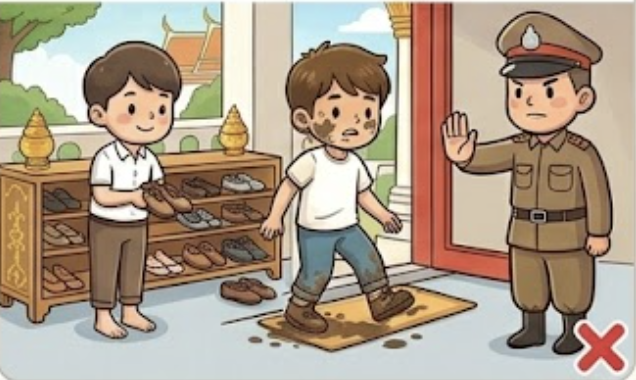
Do not walk into temple halls or homes with shoes on — staff or monks may stop you.
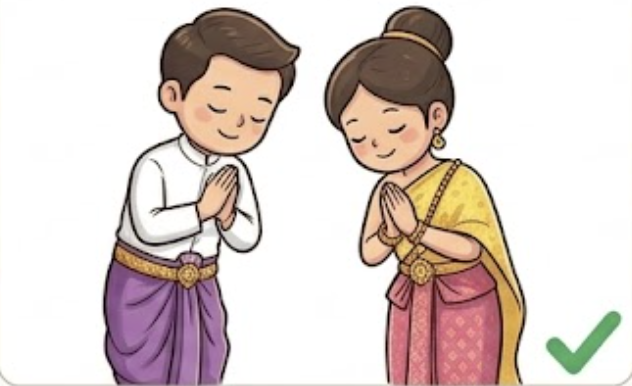
Use respectful gestures — wai, offer items with your right hand, and keep a calm posture.
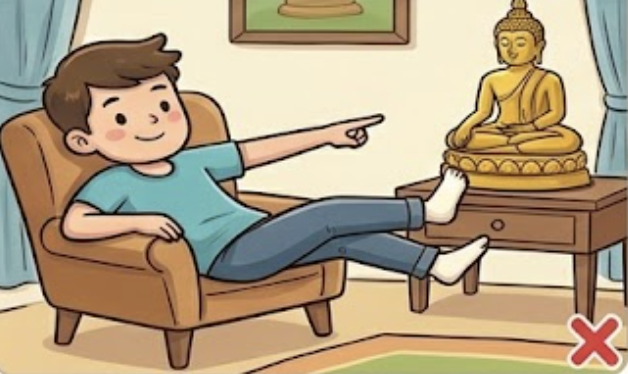
Never touch someone's head. Do not point your feet at people, Buddha images, or sacred objects.
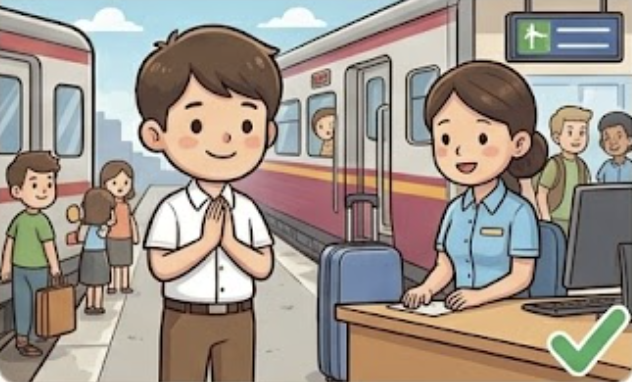
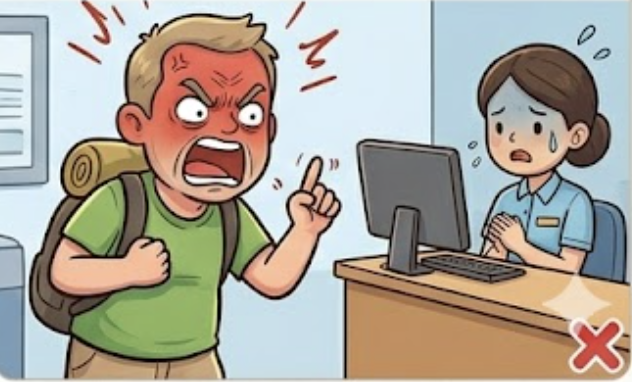
Stay calm and polite in public — a smile and quiet tone help you save face and theirs.
Avoid shouting, arguing, or humiliating staff in public — Thais strongly value saving face.
Photos, thumb height, and bow depth for monks, elders, and peers — on the Thai culture page (not duplicated here).
The head holds spiritual “khwan” (life force) — the highest, most sacred part. Feet are the lowest and unclean — never use them to point, touch people, or rest on tables.
More rules beyond the three illustrated topics — dress, monks, monarchy, beaches, and Pattaya nightlife.
Extended do's and don'ts — icon cards for topics not shown in the illustrations above.
Cover shoulders and knees at temples, Immigration, and government offices. Carry a sarong for beach-area temples.
Give up your seat on songthaews. Women do not touch monks — place offerings on a cloth.
Try "Sawasdee khrap/kha" and "Khob khun khrap/kha" with a smile — locals appreciate the effort and it opens doors to help.
Give and receive items, especially money and food, with the right hand or both hands.
Acknowledge age and status with a wai, khrap/kha, and calm tone — especially with elders and officials.
Wait your turn at Immigration, malls, and popular restaurants. Gentle tone beats cutting in line.
Never mock portraits or currency bearing the King. Pick up dropped banknotes by hand, not with your foot — strict laws apply (including for foreigners).
Even in party-town Pattaya, heavy PDA outside nightlife zones makes many Thais uncomfortable — keep it modest on streets, malls, and family areas.
Bikinis and shirtless walks belong on the sand or hotel pool only — cover up before 7-Eleven, restaurants, and main roads.
Ask before photographing monks up close. No selfies with Buddha images above your head level.
Remove shoes at spirit houses; do not litter or sit on shrine platforms.
Understanding the reason behind each rule helps you act naturally, not just memorize a list.
The head is spiritually the highest part of the body — home to “khwan,” your life force.
Feet are the lowest, dirtiest part of the body — using them to communicate is deeply rude.
Thai society values harmony and saving face — loud confrontation is seen as uncivil.
The monarchy is central to Thai identity; insult laws are among the strictest in the world.
Big Buddha, Sanctuary of Truth, Wat Yansangwararam, and local shrines.
How locals expect you to behave in this city.
Landmarks like Big Buddha (Wat Phra Yai), Wat Yansangwararam, and Sanctuary of Truth share temple rules — strict dress, quiet voices, shoes off in the ubosot.
Daytime is the beach; once you step onto the sidewalk, 7-Eleven, or a mall, put on a shirt and cover-up — shirtless men and bikinis off-sand feel disrespectful.
Tip staff when happy, respect workers' boundaries (no grabbing without consent), and call venue security or Tourist Police 1155 instead of street fights.
Dress a bit smarter than on the sand (shirt, decent shorts). Carry minimal valuables, watch bags in crowds, avoid settling disputes alone at night.
Present business cards with both hands, text facing the recipient, brief bow — read the card before pocketing (never write on it or stuff into pants). Small talk on food or weather before contracts; respect the senior person in the room.
On fixed routes, wave to board — do not ask "Can you go to…?" or you may be charged a charter fare. Press the buzzer to stop, pay 10–20 THB at the driver with small notes. Queue politely at busy stops (e.g. Wat Chaimongkol).
Pattaya police enforce helmet laws strictly — wear a certified helmet and carry your international driving permit to avoid fines and impound drama.
Frequently asked questions — Thai etiquette
Use the wai when greeting elders, monks, and officials. A slight bow is enough for casual daily interactions.
Cover shoulders and knees, remove shoes, and keep voices low. Carry a sarong for beach-area temples.
Women should not touch monks — place items on a cloth or table. Give up seats when possible.
Avoid public arguments and embarrassing others. Calm negotiation works better than confrontation.
Show respect in public. Avoid casual or critical discussion — strict laws apply.
Homes, temple buildings, and many shops — look for shoe racks or others barefoot before entering.
Yes — nightlife is commercial and loud; dress more on the street, stay alert for scams, but still avoid public fights.
Wave to board on the normal route — do not ask "Can you go to…?" Press the buzzer to stop and pay 10–20 THB in small notes at the driver.
Pick them up by hand respectfully — never step on notes or coins bearing the King's image.
Small thoughtful items (fruit, snacks, local crafts) presented with both hands. Avoid overly expensive gifts that create obligation.
Visa, housing, safety, and culture for settling in Pattaya.